Documentation that Pays (On Demand)
$125.00
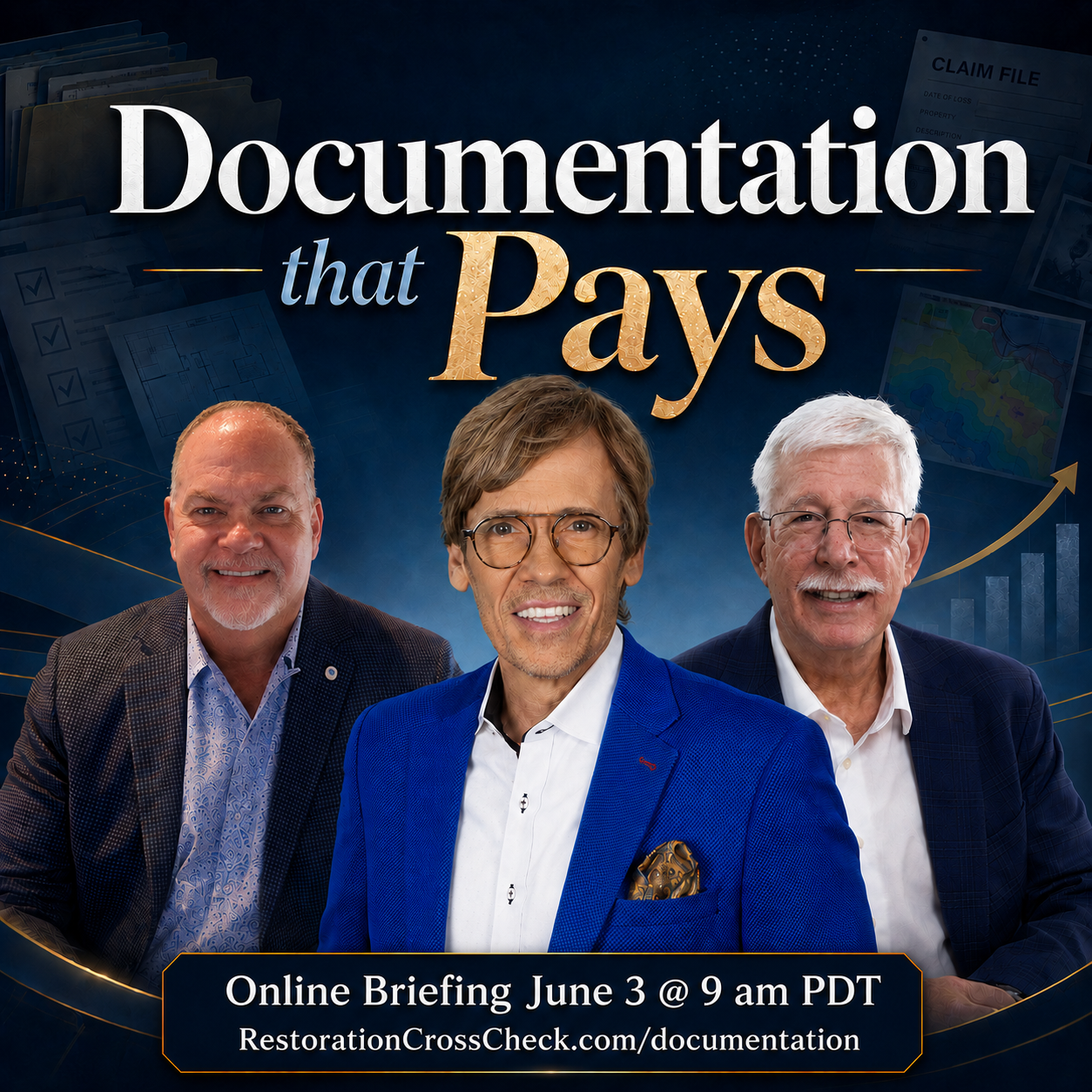
How to Tell the Story with a Well-Documented File
Description
How to Tell the Story with a Well-Documented File
with Ed Cross, and a panel of industry experts, including Greg Dillon, and Jeff Taxier
IS YOUR SUPPORTING DOCUMENTATION AI-FRIENDLY?
A human adjuster may never see your file at all.
Carriers are heavily leaning on automated auditing software. Billing rejections and settlement bottlenecks may be triggered entirely by AI.
Your documentation needs to be clearer and more precise than ever just to survive the automated gatekeeper.
Let us show you how.
WHO THIS IS FOR
This Briefing is for restoration contractors who want to:
- Get fewer reductions and fewer “we can’t verify this” responses
- Build files that match the contract terms and support the invoice
- Stop losing margin because documentation is thin, scattered, or inconsistent
- Create daily records that hold up under carrier review
WHAT WE COVER (90 Action-Packed Minutes)
1) Inside the “Bulletproof” Documentation Package
An incomplete file is an invitation for carrier pushback. We show you how to build a package that leaves zero room for debate by proving:
-
- Exactly what you did: Seamlessly aligning your field data with IICRC documentation expectations.
- Why it was necessary: Overcoming the “not justified” objection before the adjuster even brings it up.
- Contract alignment: Ensuring every physical action taken matches your contract terms and conditions.
- Rock-solid justification: Tying your final charges directly to verifiable field evidence so you get paid in full.
2) Field Habits: Building Daily Records That Adjusters Can’t Ignore
Great documentation shouldn’t slow your crew down. You will learn simple, repeatable field habits to protect your revenue:
-
- High-yield daily logs: The exact framework to flawlessly tie labor hours to specific tasks, locations, and results.
- Photos that pay: How to take and label photos that clearly prove conditions, progress, and completion—capturing the context adjusters look for.
- The “Storybook” file method: A practical way to organize your job files so the carrier can easily follow the narrative and fast-track the approval.
3) Pre-Submission Auditing: Catching Red Flags Before They Cause Delays
The fastest way to get paid is to submit a flawless file the first time. This Briefing covers the crucial final check:
-
- The “Adjuster Lens”: How to scan your own file for the specific red flags that predict automatic reductions and standard stall tactics.
- The Pre-Submission Checklist: What a comprehensive internal review must check before any invoice leaves your office.
- Tightening the file: Quick, actionable fixes to fortify a weak file and eliminate vulnerabilities before submission.
BONUS PROGRAM: FULL CIRCLE DOCUMENTATION
Your registration includes access to our popular on-demand program, Full Circle Documentation: Harnessing 360 Tech for Restoration Success, featuring Robb Harrell of DocuSketch, and hosted by Ed Cross. Robb worked at Verisk, ATI Restoration, and State Farm and gives you a unique perspective of the adjuster’s mindset and important role of geospatial 360° imagery. In this Briefing, Robb explains how restorers can catapult their efficiency with 360 technology.
FREQUENTLY ASKED QUESTIONS
Q: Why does documentation clarity matter if carriers are using AI to review it?
A: Because if the machine flags an anomaly, you get hit with an automated penalty. As carriers rely more on algorithmic screening, evidence suggests that many billing rejections are being generated straight from the software before a human adjuster ever opens your source documents. If your files aren’t crystal clear to the AI gatekeeper, the system defaults to an automatic reduction. In this Briefing, we teach you how to build files that pass algorithmic audits cleanly.
Q: Who from my team should watch this?
A: This Briefing is designed for owners, estimators, project managers, and lead technicians—essentially anyone who touches the physical job site or handles the billing. If your team in the field does not understand how their daily habits affect your final invoice, your margin is at risk. Getting your field crew and office staff on the same page is the fastest way to eliminate carrier disputes.
Q: My team already takes plenty of photos and logs. How is this different?
A: There is a massive difference between recording information and building a legal narrative that forces a carrier to pay. Most contractors lose money not because they didn’t take photos, but because their documentation didn’t explicitly prove why a specific action was necessary under IICRC standards or contract terms. We teach your team how to view a file through the “Adjuster Lens” so you can eliminate objections before they are even raised.


Reviews
There are no reviews yet.